Social Learning Platform Analysis
Platform Choice and Justification
When reflecting on the platforms I use every day, I realized that Instagram accounts for most of my screen time. While platforms like X, YouTube, or LinkedIn offer plenty of educational content, Instagram was the one I felt most compelled to examine deeply. It serves a dual purpose in my life. On one hand, it keeps me connected with friends through stories, posts, and direct messages. On the other hand, the Reels tab acts as a personalized discovery engine for my own interests.
Instagram’s algorithm is effective at curating content tailored to my actual lifestyle, surfacing everything from sports highlights and market analysis to meal prep ideas and travel clips. Instagram can be a personal learning network as users constantly create, share, and debate knowledge there. It is a web of trusted creators and peers we return to for continuous learning. So, I wanted to ask whether Instagram is genuinely helping me learn, or is it simply giving me the comfortable illusion of knowledge?
Analytical Framework
My framework evaluates Instagram using four criteria, scored from 1 (hinders learning) to 5 (supports learning).
| Criterion | Question Asked | Core Theory | Why It Matters |
| 1. Affordances | What does the design make easy or hard? | Bucher & Helmond (2018); Bates (2015) | When saving is easiest, learners collect content instead of discussing it. |
| 2. Cognitive Offloading | Which mental tasks do I delegate to the app? | Risko & Gilbert (2016) | When the app remembers for me, I remember less. |
| 3. Learning Network | Does engagement build shared understanding? | Nardi et al. (2002, as cited in Gutierrez, 2016); Garrison et al. (2000) | Following people only helps learning if we discuss ideas. |
| 4. Algorithm & Privacy | Who controls my feed, and what data pays for it? | boyd (2012) | Whoever picks what I see also picks what I learn. |
Platform Analysis
1. Affordances (Score: 3/5)
Bucher and Helmond (2018) argue that platforms shape behavior by making specific actions effortless while rendering others cumbersome. On every Reel, actions like Like, Repost, Send, and Save require a single tap. Conversely, commenting requires pausing the video to type while the next Reel waits one swipe away. Illustrating this divide, the recipe Reel in Figure 1 drew 692,000 saves but only 2,088 comments. Furthermore, these saves feed Instagram’s ranking algorithm (Mosseri, 2023), which I believe prioritizes platform retention over active dialogue.
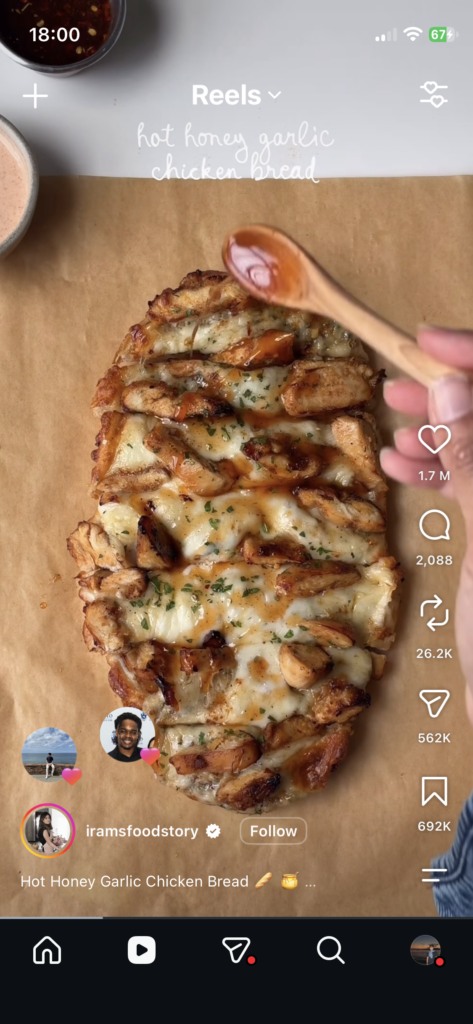
Despite this passive design bias, short-form video can support novice learners. For instance, a creator holding up a bottle to teach “un Coca” (Figure 2) alongside dual French/English captions (Figure 3) aligns with Universal Design for Learning (UDL) principles for multimodal representation (CAST, 2024). However, whereas UDL assumes the learner chooses their format, Instagram’s algorithm decides the format for me resulting in what Bates (2015) describes as a loss of learner control.


This seamless interface also drives reposting. I can share news in seconds without any prompt to check sources. As Wardle and Derakhshan (2017) show, information disorder spreads through unchecked sharing, often driven by a desire to signal belonging rather than inform. While Bucher and Helmond explain how the interface makes sharing effortless, Wardle and Derakhshan explain why users share without checking.
2. Cognitive Offloading (Score: 2/5)
Risko and Gilbert (2016) define cognitive offloading as using tools “to reduce cognitive demand” (p. 676). While this frees short-term memory, it frequently weakens long-term recall. Instagram encourages this offloading in two distinct ways:
- External Memory: I have saved over 30 recipes while cooking only 3 or 4. The saving option acts as an easy alternative to memory (Risko & Gilbert, 2016).
- Delegated Analysis: Creator Kyla Scanlon condenses an interview with Chicago Fed President Austan Goolsbee into a Reel (Figure 4), leading me to absorb her conclusions without analyzing the underlying evidence.

Similarly, credibility decisions are offloaded to social cues. The “Followed by…” label (Figure 4) encourages immediate trust based on peer connections. While social trust can be an asset for learning networks, Wardle and Derakhshan (2017) warn that it causes peer-shared content to go unquestioned.
3. Learning Network (Score: 3/5)
Evaluating social connections on the platform reveals a tension between social activity and critical thinking. Network activity happens across three purposes (Nardi et al., 2002, as cited in Gutierrez, 2016): building (following creators), maintaining (friend activity bubbles; Figure 1), and activating (sending Reels).
However, Garrison et al.’s (2000) Community of Inquiry framework sets a higher standard. A like signals social presence but lacks cognitive presence. The readings differ because Gutierrez (2016) frames personal learning networks around professional development, where activating connections marks success, whereas Garrison et al. studied students needing shared understanding. Consequently, Instagram heavily rewards social activation while rarely cultivating deep inquiry.
4. Algorithm & Privacy (Score: 2/5)
Instagram’s “Your Algorithm” panel (added December 2025) lists inferred interests like “cricket matches, AI tech and picking up french” (Malik, 2025; Figure 5).
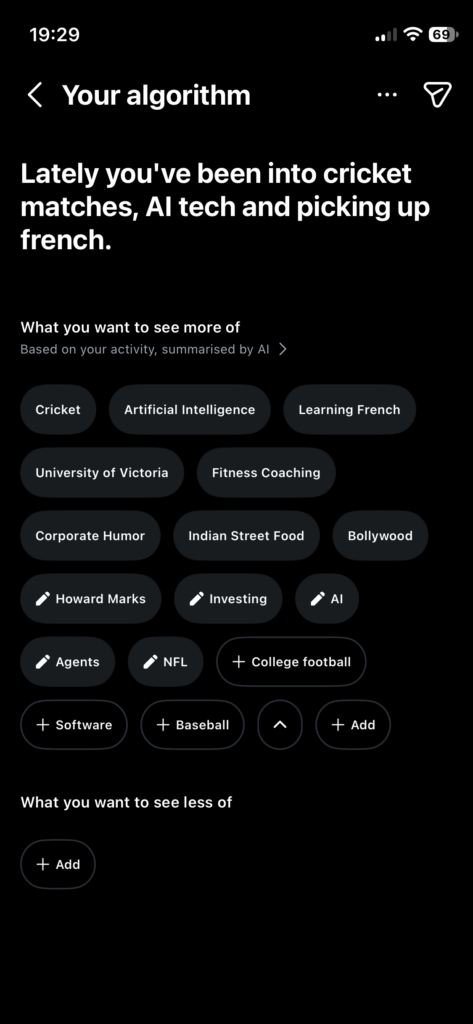
Without my input, the system also inferred tags like “University of Victoria” and “Bollywood” from passive location and activity data. While users can remove tags, modifying a profile written by an algorithm falls short of full learner control (boyd, 2012). More surprisingly, topics I discuss with friends in person also appear in my feed. Instagram head Adam Mosseri denies that the app listens through the microphone. He says these matches come from users’ activity and their friends’ interests (The Daily Star, 2025). Even so, that explanation supports boyd’s (2012) argument that privacy is networked; the same peers who enrich my learning network also shape what the platform knows about me.
Reflection and Implications
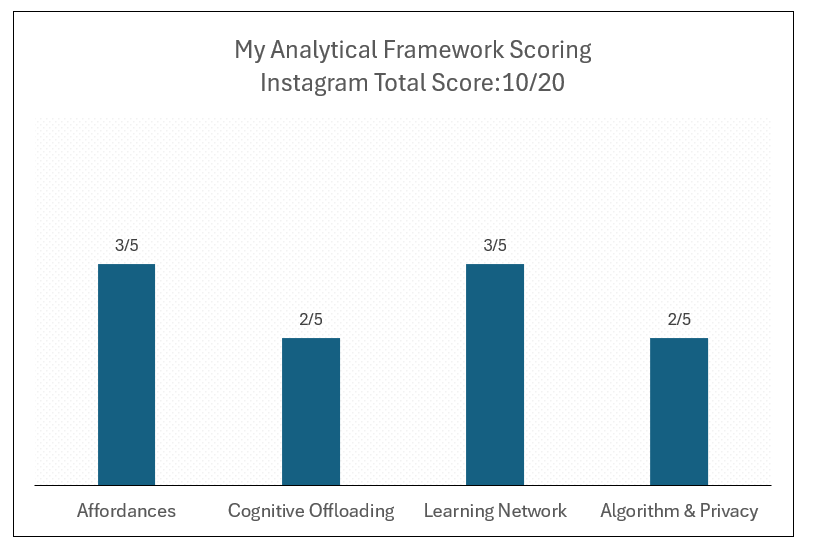
As seen in Figure 6, Instagram scores 10 out of 20 overall. Instagram excels at content discovery and peer connection but struggles to support long term retention. It enables learners who already act on what they save and check their sources. It constrains learners who need structure, practice, or feedback, since scrolling past a French Reel will never correct my pronunciation.
The readings also show who holds power. Nardi et al. value the connections Instagram makes easy, while Garrison et al., Bates, and boyd show their cost to understanding, agency, and privacy. Instagram profits when I save, share, and scroll, and the inferences that personalize my feed also make me more valuable to advertisers.
Moving forward, I will be more intentional about not saving and forgetting, and instead actually learning from what I save and telling my friends about it. For instance, I will cook a saved recipe first before saving another one.
I am curious if saving a post has ever led to real learning for you? I would love to read about it in our Teams thread!
References
Bates, A. W. (2015). Choosing and using media in education: The SECTIONS model (Chapter 8). In Teaching in a digital age: Guidelines for designing teaching and learning. Tony Bates Associates. https://opentextbc.ca/teachinginadigitalage/part/9-pedagogical-differences-between-media/
boyd, d. (2012). Networked privacy. Surveillance & Society, 10(3/4), 348–350. https://doi.org/10.24908/ss.v10i3/4.4529
Bucher, T., & Helmond, A. (2018). The affordances of social media platforms. In J. Burgess, A. Marwick, & T. Poell (Eds.), The SAGE handbook of social media (pp. 233–253). SAGE Publications.
CAST. (2024). Universal Design for Learning Guidelines version 3.0. https://udlguidelines.cast.org
The Daily Star. (2025, October 1). We do not use the phone’s microphone to eavesdrop on you, says Instagram head. https://www.thedailystar.net/tech-startup/news/we-do-not-use-phones-microphone-eavesdrop-you-says-instagram-head-3999881
Garrison, D. R., Anderson, T., & Archer, W. (2000). Critical inquiry in a text-based environment: Computer conferencing in higher education. The Internet and Higher Education, 2(2–3), 87–105. https://doi.org/10.1016/S1096-7516(00)00016-6
Gutierrez, K. (2016, June 21). What are personal learning networks? SHIFT eLearning. https://www.shiftelearning.com/blog/personal-learning-networks
Malik, A. (2025, December 10). Instagram’s new “Your Algorithm” tool gives you more control over the Reels you see. TechCrunch. https://techcrunch.com/2025/12/10/instagrams-new-your-algorithm-tool-gives-you-more-control-over-the-reels-you-see
Mosseri, A. (2023, May 31). Instagram ranking explained. Instagram. https://about.instagram.com/blog/announcements/instagram-ranking-explained
Risko, E. F., & Gilbert, S. J. (2016). Cognitive offloading. Trends in Cognitive Sciences, 20(9), 676–688. https://doi.org/10.1016/j.tics.2016.07.002
Wardle, C., & Derakhshan, H. (2017). Information disorder: Toward an interdisciplinary framework for research and policy making (Council of Europe report DGI(2017)09). Council of Europe. https://rm.coe.int/information-disorder-report-november-2017/1680764666