Analyzing Your Digital Identity – CC 2
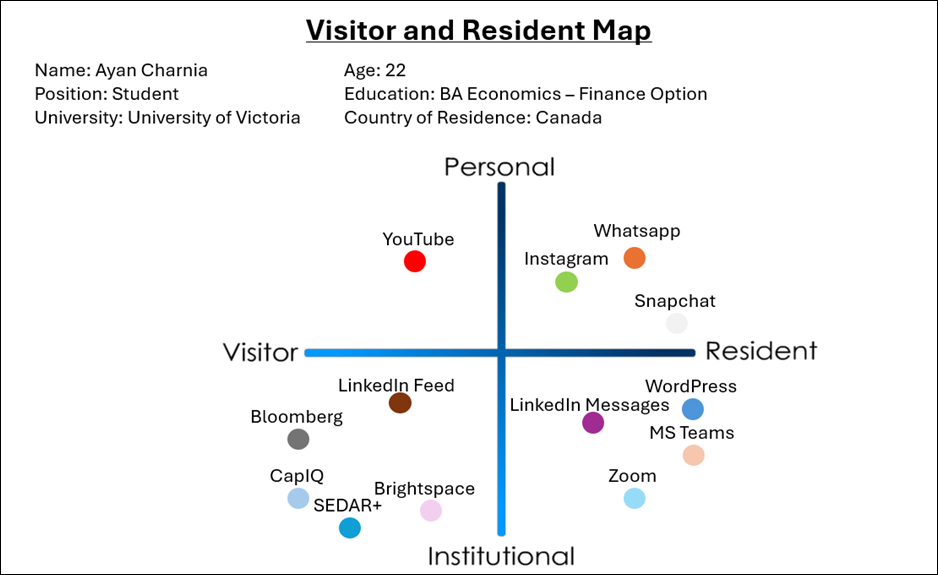
When I mapped my digital life using the Visitors and Residents framework, I realized how much my engagement depends on my curiosity and the task in front of me. During my work terms, I frequently pulled filings from SEDAR+ and analyzed numbers on CapIQ and Bloomberg. In those moments, I treated the web like White and Le Cornu’s garden shed: grab the tool, finish the work, and leave no trace behind.
My Resident activity is much smaller and highly deliberate. I rarely post on LinkedIn, choosing instead to send private messages for coffee chats or leave comments celebrating my peers’ achievements. This made me question the framework slightly. A direct message definitely leaves a trace, but only one person sees it. Some of my most valuable networking happens in this quiet Resident mode, which a standard map struggles to capture. However, I do use Instragram, Snapchat, and Whatsapp to keep up with friends and family.
This distinction matters when an employer searches my name. Robles-Carrillo (2024) describes digital identity as the accumulated sum of our data points, so recruiters only see assembled fragments. That’s why I’m intentional about which posts I like or comment on. Hartzog (2014) argues that privacy is really about obscurity rather than perfect erasure, and that matches my approach: my supportive comments stay visible, while most of my networking happens privately and the few personal posts I share live on separate platforms like Instagram and WhatsApp.
Still, perfect control over these fragments is impossible. White and Le Cornu, drawing on Stewart, describe how the web blends audiences into “collapsed publics,” where a casual comment can reach a future employer or current colleague. Eggers (2026) shows the extreme version of this risk, explaining how deepfakes prompted Denmark to create a property right over a person’s digital likeness. If even someone’s face and voice can be copied, I can’t control every fragment, so intentionality becomes my strategy for portraying myself accurately online.
This leaves me wondering: do private messages count as Resident activity for you, and where did they land on your map?