Community Contribution Formal Feedback
I recently watched The Social Reckoning, Aaron Sorkin’s film about Facebook whistleblower Frances Haugen, and it was an awakening moment for me. It showed how platforms build algorithms to maximize engagement by amplifying anger, shaping our politics and daily choices. I wanted to loop this back into our course teachings to better understand the dynamics of social media and how it impacts our personal learning networks.
The trailer for The Social Reckoning, which dramatizes Haugen’s decision to leak the Facebook Files (Sony Pictures Entertainment, 2026).
In CC4, I explored how Instagram pushes football shoes to my feed based on ad spend, demonstrating how platform affordances serve advertisers (Bucher & Helmond, 2018). But algorithmic manipulation goes far deeper than targeted shopping. Wardle and Derakhshan (2017) categorize this systemic failure as information disorder, driven by algorithms optimizing for attention at all costs.
This optimization is what enabled Facebook’s 2018 shift toward meaningful social interactions, or MSI. Prioritizing comments and reshares among friends and family sounded constructive, but internal memos revealed that misinformation and toxicity flourished precisely within reshares (Hagey & Horwitz, 2021). As Haugen noted, it is easier to inspire people to anger than to any other emotion (CBS News, 2021).
To understand why these recommendation feeds hold so much power, Nguyen (2020) separates two structures that often get lumped together:
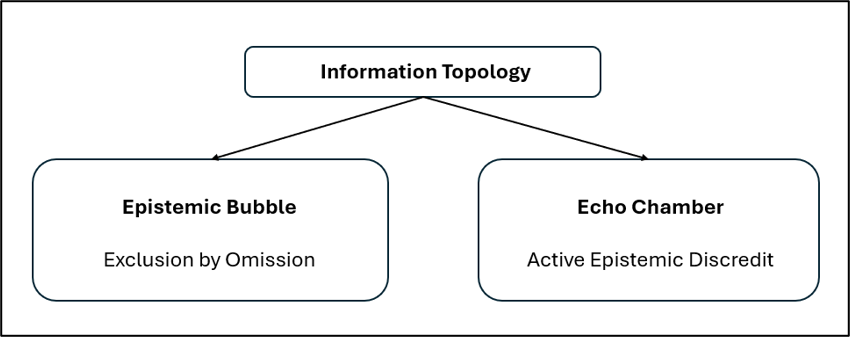
Figure 1: Epistemic bubbles versus echo chambers (adapted from Nguyen, 2020)
In an epistemic bubble, we never hear opposing viewpoints. In an echo chamber, we encounter those viewpoints but have been conditioned not to trust them. Nguyen also emphasizes that members of echo chambers are not merely gullible. Because we rely on others for knowledge, “echo chambers prey on our epistemic interdependence” (Nguyen, 2020, p. 143). Wardle and Derakhshan (2017) add that we inherently trust messages from people we know, even when we suspect they are false. I notice this in family WhatsApp chats, where a forwarded link arrives carrying the relational trust of the sender. When a relative sent an alarming forward about local crime, I almost shared it without checking. It made me reflect on how often I have reshared something because of who sent it rather than what it actually contained. MSI took that personal trust and weaponized it across an entire feed.
Beyond North America, these algorithms carry devastating real world consequences. Wardle and Derakhshan (2017) document how an unverified Facebook rumor sparked the 2014 Mandalay riots in Myanmar, where ~500 people left two dead. Meanwhile, the Facebook Files revealed that European political parties felt pressured by platform algorithms to alter core policy positions (Hagey & Horwitz, 2021). This made me realize how systems designed to maximize screen time ultimately reshaped democratic promises.
What frustrates me most is that the necessary technical fixes and the underlying business model of social media work in direct opposition to each other. As Wardle and Derakhshan (2017) point out, if platforms showed us challenging material that forced us to reconsider our established worldviews, users would likely spend far less time engaging with them (p. 52). That is why my primary goal is to intentionally keep people in my personal learning network who see the world differently, earning enough mutual trust that we actually listen to one another.
In conclusion, if facts alone cannot break an echo chamber, then trust inside our personal learning networks matters more than ever. Has someone in your PLN ever changed your mind because you trusted them, even when facts had not? I would love to hear your stories in our discussion on Teams!
References
Bucher, T., & Helmond, A. (2018). The affordances of social media platforms. In J. Burgess, A. Marwick, & T. Poell (Eds.), The SAGE handbook of social media (pp. 233–253). SAGE Publications.
CBS News. (2021, October 4). Whistleblower: Facebook is misleading the public on progress against hate speech, violence, misinformation. 60 Minutes. https://www.cbsnews.com/news/facebook-whistleblower-frances-haugen-misinformation-public-60-minutes-2021-10-03/
Hagey, K., & Horwitz, J. (2021, September 15). Facebook tried to make its platform a healthier place. It got angrier instead. The Wall Street Journal. https://www.wsj.com/articles/facebook-algorithm-change-zuckerberg-11631654215
Nguyen, C. T. (2020). Echo chambers and epistemic bubbles. Episteme, 17(2), 141–161. https://doi.org/10.1017/epi.2018.32
Sony Pictures Entertainment. (2026). The Social Reckoning: New trailer [Video]. YouTube. https://www.youtube.com/watch?v=MfHEZw7Xw_c
Wardle, C., & Derakhshan, H. (2017). Information disorder: Toward an interdisciplinary framework for research and policy making (Report DGI(2017)09). Council of Europe.